Mar 17, 2026
A Founder's Guide to Web App Development Services in 2026
Discover modern web app development services. Learn the stages, compare no-code vs traditional coding, and see how you can build your app faster and smarter.
So, what exactly are web app development services? Think of it like this: you have a brilliant idea for a digital product, but you need the right team to actually build it. That's where these services come in.
It’s the difference between having a blueprint for a house and having a finished, move-in-ready home. You’re hiring the architects, engineers, and construction crew—all rolled into one—to handle everything from the initial design to the final launch and ongoing upkeep of your web app.
Understanding Modern Web App Development Services
At its heart, web app development is a structured process that takes a raw idea and turns it into a real, functioning product that people can use in their web browser. For founders who don't come from a technical background, the jargon can feel overwhelming, but the process itself is surprisingly logical.
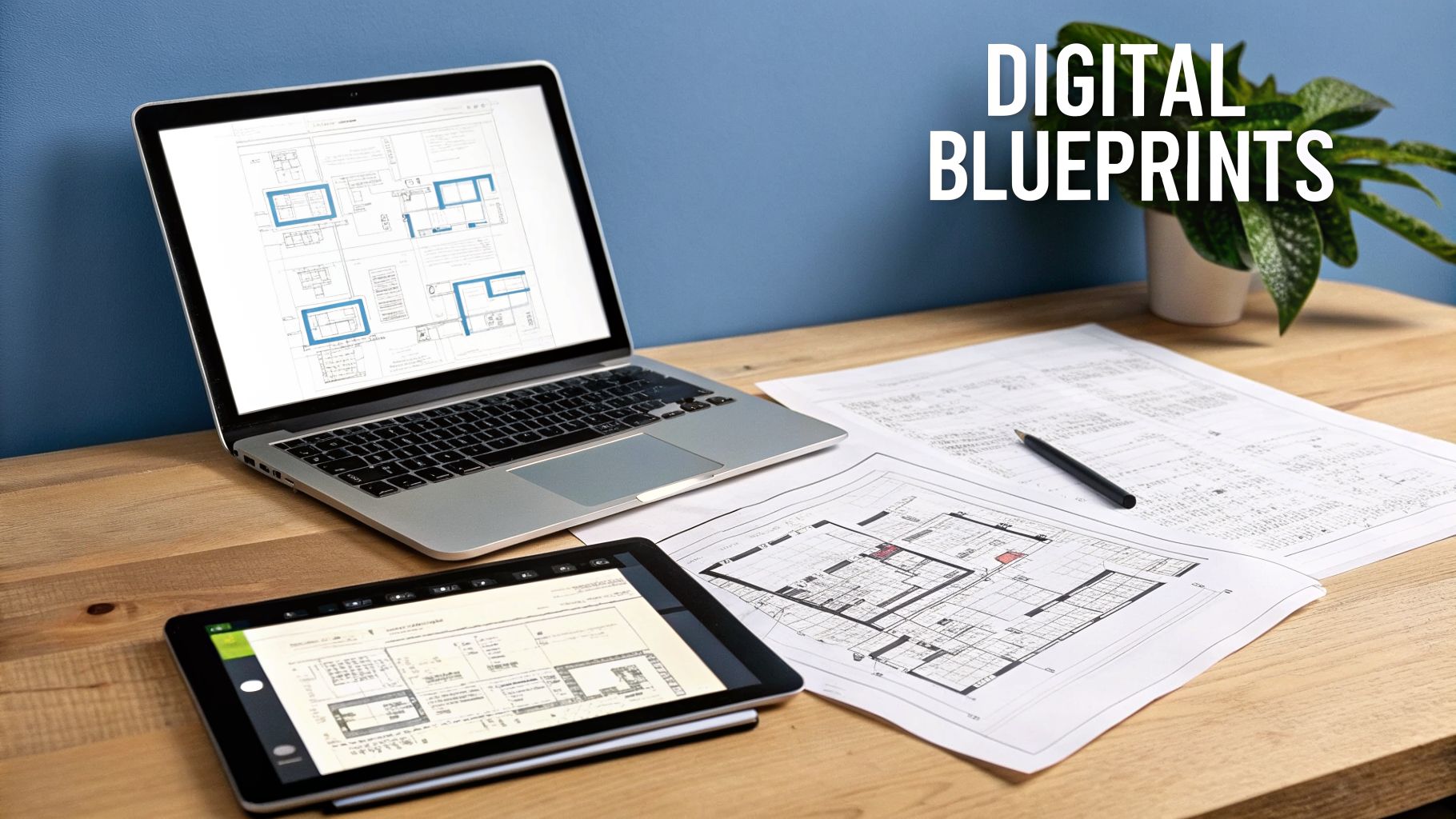
Just as a builder would never pour a foundation without detailed blueprints, a development team won't write a single line of code without a solid plan. This initial planning phase—covering project scope, user experience design, and backend architecture—is absolutely critical to getting it right.
The Core Components of Development
While every project is different, most professional builds will move through a few key stages. Think of these as the essential services bundled into a typical development project:
Discovery and Scoping: This is where we nail down the specifics. What problem does your app solve? Who is it for? What are the must-have features? This stage sets the entire project's direction.
UI/UX Design: Here, we focus on the look and feel. The User Interface (UI) is the visual design, while the User Experience (UX) ensures the app is intuitive, logical, and easy to navigate.
Backend Development: This is the engine under the hood. It’s all the stuff users don’t see—the database, server logic, and API integrations that power the entire application.
Frontend Development: This is where the designs come to life. The frontend is the part of the app that users actually see and interact with, built to match the UI/UX plans perfectly.
Taking this structured approach is what separates a professional application from a weekend hobby project. It's no surprise that the demand for these skills is skyrocketing. The global application development software market, valued at USD 172.94 billion in 2026, is projected to hit an incredible USD 826.48 billion by 2034. That’s a compound annual growth rate of 21.60%.
You can dig into the numbers yourself by checking out the full market analysis of these application development trends on Fortune Business Insights.
For founders, this explosive growth is fantastic news. It means more tools, smarter technology, and a lower barrier to entry than ever before. You no longer need to be a coding guru to build something powerful.
This evolution has opened up two main paths for bringing your app idea to life. You can go the traditional route and hire a team to custom-code everything from scratch, or you can take a more modern approach using no-code platforms. Let's break down both options so you can figure out which path makes the most sense for you.
Navigating the Web App Development Lifecycle
Every web application, whether it's a simple tool for your team or a massive public-facing platform, has to get from an idea in your head to a product on a screen. This journey has a predictable path. As a founder, understanding this path is your single best defense against blown budgets, missed deadlines, and a final product that doesn't actually solve the problem you set out to fix.
Think about it like building a custom car. You don't just show up with a pile of metal and start welding. You’d have a clear vision, draft detailed blueprints, carefully assemble the engine and chassis, and test everything from the brakes to the headlights before it ever hits the road. The world of web app development services works the exact same way.
The Five Stages of Development
Most successful projects—whether they're built with a team of coders or on a no-code platform—move through five core phases. The tools might change, but the logic behind this process is universal. It's what keeps a project on track and ensures the thing you build is the thing you meant to build.
Here’s what that flow typically looks like:
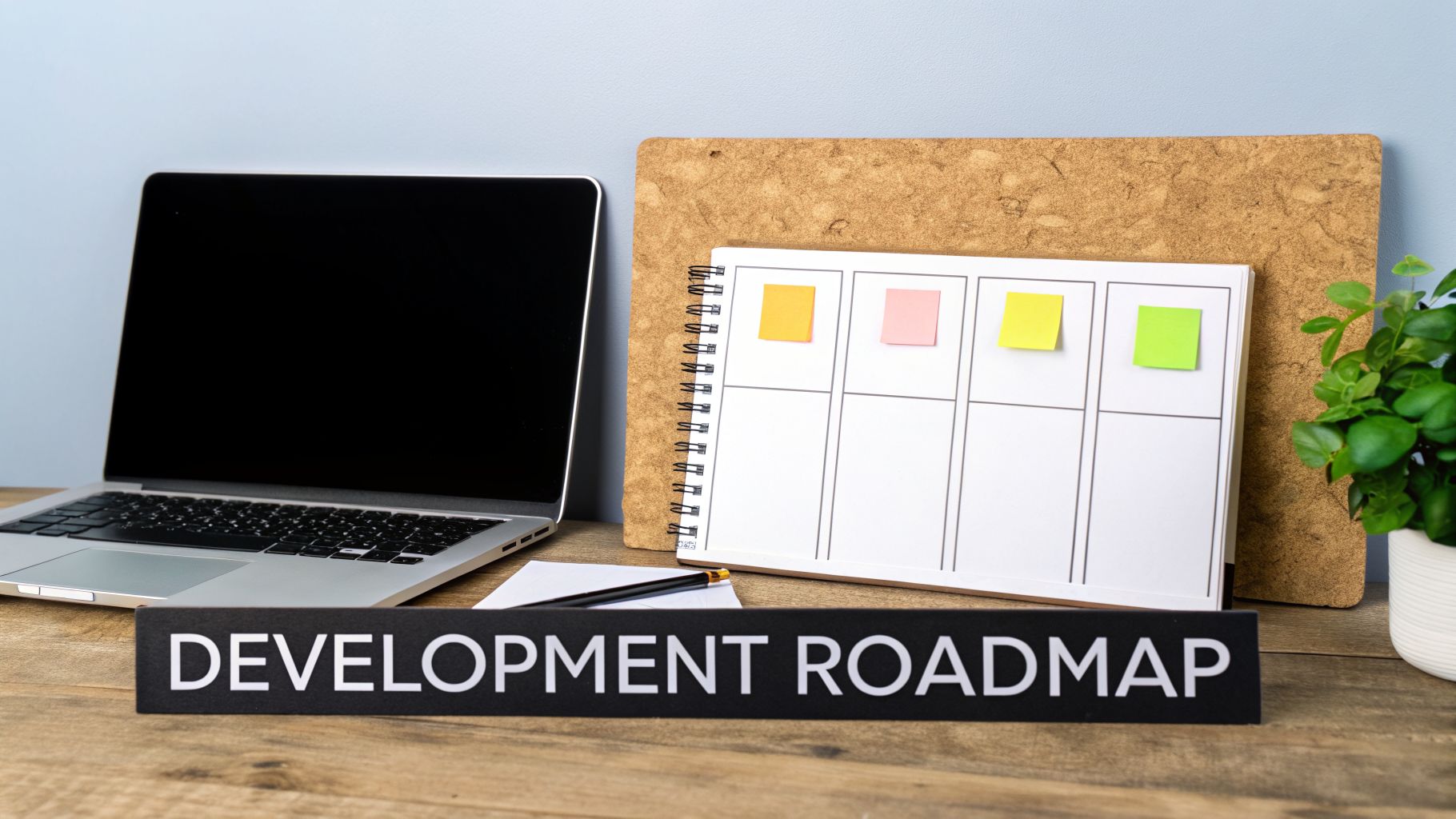
Discovery & Strategy: This is where it all begins—the blueprinting stage. You’re not writing a single line of code. Instead, you're defining the core problem, figuring out exactly who your users are, and deciding on the absolute essential features for a Minimum Viable Product (MVP). It's all about answering the "why" and "what" before you get tangled up in the "how."
Design (UI/UX): With a clear strategy, you can start thinking about what your app will look and feel like. UI (User Interface) is the visual design—the colors, fonts, and layout. UX (User Experience) is all about the flow, ensuring the app is logical, intuitive, and easy for people to use. This stage produces the visual guide for your entire application.
Development: Now it's time to build. This is the construction phase where developers (or you, using a tool like Bubble) bring the designs to life. They build the frontend that users see and the backend logic that makes it all work, from the database that stores information to the integrations that connect your app to other services.
Testing & QA: Before you pop the champagne, the app needs to be put through its paces. Quality Assurance (QA) testers act like your most critical users, intentionally trying to break things. They hunt for bugs, check for performance issues, and make sure everything works perfectly on different web browsers and devices. This is what separates a professional launch from a frustrating, buggy one.
Deployment & Maintenance: Go-live! The app is pushed to a server and made available to your users. But the work isn't over. Great apps require ongoing maintenance, bug fixes, and feature updates to stay relevant and secure. This is the long-term commitment to your product's success.
Understanding this lifecycle isn’t just an academic exercise. It’s your practical guide for talking to developers, creating a realistic budget, and spotting potential roadblocks before they become project-killers.
Knowing these stages is the first step, but how you move through them can make all the difference. If you're looking to build faster and get user feedback sooner, you might want to explore different development philosophies. We break down one of the most effective methods in our guide on the rapid application development methodology.
Why Progressive Web Apps Are a Game Changer
Imagine launching your app without ever having to deal with the App Store or Google Play. That’s the reality with a Progressive Web App (PWA). At its core, a PWA is your website, just with superpowers. It gives users a native app-like experience right from their web browser.
This means people can "install" your site onto their phone's home screen with a single tap, get push notifications from you, and even use parts of your app when they’re offline. For a founder trying to launch a first version (MVP), this isn't just a nice feature—it's a massive strategic advantage.
The Best of Both Worlds
PWAs elegantly blend the discoverability of a website with the immersive feel of a mobile app. This hybrid approach is particularly powerful for new products because it solves several common roadblocks right out of the gate.
Skip the App Store Friction: Users don't have to search for you in a crowded marketplace. They can find your site on the web and instantly add it to their home screen, removing a huge barrier to adoption.
Works Even When Offline: Unlike a standard website, key features of your PWA can remain available without an internet connection. This makes for a far more reliable and sticky user experience.
Bring Users Back with Push Notifications: You can send timely alerts and updates directly to a user's device, a powerful retention tool that was once reserved for native apps.
This model is catching on fast. The global PWA market is projected to hit USD 3.32 billion in 2026 and skyrocket to USD 22.48 billion by 2033, fueled by a staggering 31.4% compound annual growth rate. You can dive into the full PWA market forecast from Coherent Market Insights to see just how big this trend is becoming.
A PWA gives you the direct user relationship of a mobile app without the gatekeepers. You avoid the lengthy app store review processes and the notorious 30% commission on sales.
This is where pairing modern web app development services with no-code tools gets really exciting. Platforms like Bubble.io let you build an application with all these PWA-like capabilities yourself, without writing a line of code. You can create a product that feels native, works everywhere, and gets into the hands of your customers faster and more affordably than ever.
Choosing Your Development Path: No-Code vs. Traditional Coding
So, you’ve validated your app idea. Now comes the big question every founder hits: how do you actually get it built? You're standing at a fork in the road. One path leads to a traditional development agency, the other to a no-code platform paired with expert coaching. The right choice isn’t about which is "better," but which is right for your project, your budget, and how fast you need to move.
Traditional code is still the undisputed king for certain projects. If your app involves highly proprietary algorithms, needs extreme computational power, or has to meet very specific compliance rules—think financial trading platforms or complex scientific modeling—then a custom-coded solution is likely the only way to go.
But here’s the thing: most modern business ideas don't fall into that category. For the marketplaces, social networks, internal tools, and SaaS products that most founders dream up, the no-code route has become an incredibly powerful alternative. It delivers on speed, keeps costs down, and gives you the agility to build and adapt on the fly.
The Rise of No-Code Dominance
This move towards visual development is more than just a passing trend; it’s a genuine market shift. Platforms for low-code no-code development are fundamentally changing the game by letting non-technical founders build sophisticated apps for a fraction of what it used to cost.
The numbers don't lie. By 2024-2025, these tools captured over 55% of the application development market. The market for low-code alone is expected to skyrocket from USD 57.0 billion in 2025 to a massive USD 388.6 billion by 2034, which shows just how much the industry is embracing this new way of building.
This approach is especially effective for building Progressive Web Apps (PWAs). A PWA gives you an app-like experience right in a web browser, often removing the need to build separate, expensive native apps for iOS and Android. This flowchart breaks down when a PWA is the smartest move.
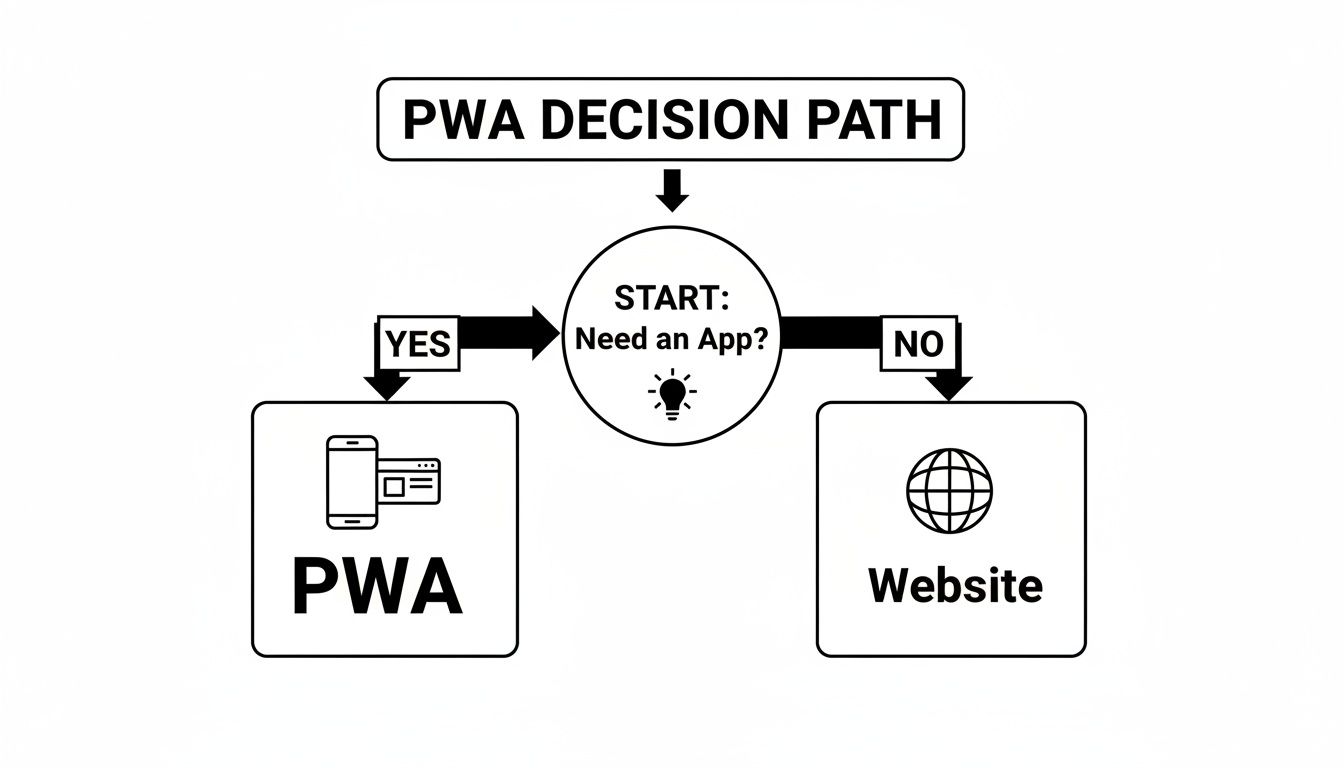
As you can see, if you need features like offline access or push notifications, a PWA is a direct and highly efficient path forward.
A coaching model is a strategic partnership. It's not about outsourcing your vision; it's about getting the expert guidance to build it yourself, maintain full control, and truly own your product without the six-figure price tag of an agency.
Making the Right Choice for Your App
To help you decide, let's go beyond a simple pros and cons list. The decision matrix below frames the choice around the factors that matter most to early-stage founders: speed, cost, and control.
Decision Matrix: No-Code Coaching vs. Traditional Agency
This table directly compares the two paths to help you see which one aligns with your immediate goals and long-term vision.
Factor | No-Code with Coaching (e.g., Codeless Coach) | Traditional Dev Agency |
|---|---|---|
Speed to MVP | Weeks. You can launch a functional first version incredibly fast. | Months. The traditional cycle of scoping, sprints, and testing takes time. |
Initial Cost | Low. Your primary cost is the coaching fee, not a massive project budget. | High. Projects often start with a large retainer and can cost $50,0_0_0–$250,000+. |
Founder Control | Total Control. You're in the driver's seat, building your vision directly. | Limited Control. You're dependent on the agency's team, timeline, and interpretation. |
Iteration Agility | Extremely High. Make changes instantly based on user feedback without scope creep. | Low & Costly. Changes require new work orders, adding time and expense. |
Long-Term Ownership | You Own It All. You have the skills to maintain, update, and scale the app yourself. | Vendor Lock-In. You're reliant on the agency for every future update or bug fix. |
Best For | MVPs, most SaaS platforms, internal tools, marketplaces, and social apps. | Highly specialized apps with complex algorithms, niche hardware integrations, or deep enterprise needs. |
Ultimately, choosing your path comes down to aligning your development method with your business goals. For many, integrating some of the best no-code automation tools can further accelerate the process. The no-code with coaching model puts the power back where it belongs: with you, the founder.
All the theory in the world can't compete with seeing what’s actually being built. The true magic of pairing no-code tools with expert web app development services really comes to life when you look at the founders who’ve already walked this path. These aren't just textbook examples; they're real businesses, built from the ground up on platforms like Bubble.
How Real Founders Built Success with No-Code

Take the classic story of a founder with a fantastic idea but zero coding background. The old playbook would have them spending months—even years—searching for a technical co-founder. Instead, this founder chose to build their Minimum Viable Product (MVP) themselves.
Using Bubble, they put together a working version of their app in a matter of weeks. They launched on Product Hunt, got instant traction, and started collecting invaluable user feedback. This allowed them to make changes and push updates in real-time, a level of agility that’s nearly impossible with a rigid, traditional development cycle.
Automating Operations for Small Businesses
It’s not just about launching the next big thing, either. Think about a small business owner who’s practically drowning in manual tasks. They’re stuck copying data from one spreadsheet to another, sending the same emails over and over, and tracking orders by hand. It's a recipe for burnout and human error.
The fix? A custom internal dashboard built on Bubble, using Zapier to connect the tools they already loved. Suddenly, their workflow looked completely different.
New orders automatically fired off tasks in Trello.
Customer details were seamlessly synced to their Mailchimp audience.
Sales figures populated a Google Sheet for at-a-glance analysis.
This simple automation saved them over 15 hours per week. That’s time they could finally spend on growing the business instead of just running it. It’s a perfect illustration of how no-code helps business owners solve their own problems without a huge budget.
The most impactful takeaway from these stories is empowerment. No-code, guided by expert coaching, puts you in direct control of your vision, turning you from an ideas person into a builder.
From Designer to SaaS Founder
Here's one more. We worked with a gifted UI/UX designer who had a brilliant idea for a Software-as-a-Service (SaaS) product. They knew precisely how the app needed to look, feel, and function, but the backend coding was a complete mystery.
Instead of handing their vision off to a developer and hoping for the best, they built it themselves on Bubble. This gave them the power to bring their pixel-perfect designs to life, handling everything from user logins to integrating Stripe for payments. They launched and scaled a polished, market-ready product, all on their own terms.
So, You're Ready to Build Your Web App. What's Next?
That initial spark of inspiration is powerful. But if you're a non-technical founder, it's easy to get stuck watching endless tutorials, feeling like you're spinning your wheels. The most direct path from idea to a working product isn't about becoming a developer overnight; it's about getting targeted, expert guidance when you need it most.
This is exactly why a coaching model for web app development services works so well. It’s not about handing your idea off to someone else and hoping for the best. It’s about empowering you to build, with an expert in your corner to help you skip weeks of frustrating trial-and-error.
Get Unstuck with Expert Coaching
A handful of one-on-one sessions can do more for your progress than a month of guessing. You get direct, hands-on help with the exact roadblock you're facing right now.
I've seen founders break through common hurdles that can stall a project for good:
API Integrations: Figuring out how to connect essential tools like Stripe for payments or Twilio for text messaging.
Database Design: This is a big one. Structuring your data correctly from day one saves you from massive headaches down the road.
Responsive Layouts: Making sure your app looks and functions perfectly on a tiny phone screen, a tablet, and a giant desktop monitor.
The right guidance is often the one thing that separates a project that fizzles out from one that actually launches. You'll build, test, and improve your app faster, turning your vision into a real product without the six-figure price tag of a traditional agency.
Of course, planning your budget is a critical piece of the puzzle. To get a clearer picture of what to expect, take a look at our guide on how much app development costs. It will help you set a realistic financial plan.
Finally, remember that building the app is only half the battle. Preparing for your big debut is just as important. A solid Product Launch Checklist is an invaluable tool for organizing your marketing and making sure you hit the ground running.
Your Web App Development Questions, Answered
If you're diving into web app development for the first time, you probably have a lot of questions. That’s completely normal. I've worked with countless founders, and these are the concerns that come up again and again. Let's clear things up so you can move forward with confidence.
What Is the Difference Between a Website and a Web App?
I get this question all the time. The easiest way to think about it is that a website tells you something, while a web app does something.
A standard website is like a static, high-quality magazine. You can read articles, look at pictures, and find contact info, but you can't really change it. A web app, on the other hand, is an interactive tool. Think of managing your projects in Trello, booking a vacation on Airbnb, or sorting your inbox in Gmail. You’re logging in, creating data, and making things happen. They're built for user engagement, not just information.
Can a No-Code App Actually Scale for Thousands of Users?
Yes, absolutely. It's a persistent myth that no-code tools can't handle real-world traffic, but platforms like Bubble.io are engineered to support serious growth. The real bottleneck isn't the technology; it's the app's internal structure.
I’ve seen plenty of successful apps built entirely on Bubble that serve thousands of happy users. The secret is getting the database architecture and workflows right from day one. With a smart foundation, your app will have no problem scaling as you grow.
The biggest barrier to scaling a no-code app isn't the technology—it's inefficient app design. A well-structured app will perform well under pressure, while a poorly planned one will struggle, regardless of the tools used.
How Much Does It Really Cost to Build a Web App?
This is the big one, and the answer can be scary. If you go the traditional route with a development agency, you're often looking at a price tag between $50,000 and over $250,000, depending on the features you need.
Building with no-code is a completely different ballgame. Instead of a massive upfront investment, your main cost is targeted coaching to make sure you're building the right way. This keeps your total investment in the low thousands—a tiny fraction of the agency model.
How Long Does It Take to Build an MVP with Bubble?
With a clear idea and some focused effort, you can launch a Minimum Viable Product (MVP) on Bubble in just a few weeks. Forget the months-long development cycles you hear about with traditional code.
The visual nature of Bubble means you can build a feature, test it, get feedback, and make changes incredibly fast. This rapid iteration is exactly what you need to get your product in front of real users as quickly as possible.
Feeling ready to turn your idea into a reality but need a little help getting unstuck? At Codeless Coach, we specialize in one-on-one coaching to help you build faster and smarter on Bubble. Book a session today and let's start building your app together.