Feb 27, 2026
Bubble Coaching: The Ultimate Guide To Launching Your App Faster
Struggling with Bubble.io? Discover how expert Bubble coaching offers personalized 1-on-1 tutoring to help you build, launch, and scale your app without code.
Ever found yourself staring at the Bubble.io editor, knowing exactly what you want to build but feeling completely stuck on how to make it happen? You're definitely not alone. The fastest way to bridge that gap between a great idea and a working product is Bubble coaching—working directly with an expert in tailored 1-to-1 tutoring sessions. It can save you weeks of painful trial-and-error.
Why Bubble Coaching Is The Ultimate Shortcut To No-Code Success
Learning a powerful platform like Bubble can feel like trying to explore a new city with a torn, outdated paper map. You know your destination, but every turn seems to lead down a confusing, dead-end street. You might spend hours digging through forums or watching generic video tutorials, only to realize they don’t quite solve the unique problem you're facing.
This slow, frustrating crawl is the reality for so many aspiring no-code builders.
This is exactly where personalized Bubble coaching from Codeless.coach changes the game. It’s like trading that crumpled map for a local guide who knows every shortcut, hidden gem, and pothole to avoid.
Accelerate Your Learning Curve
A great coach doesn't just hand you answers; they teach you how to think through problems yourself. In a tailored 1-to-1 tutoring session, the focus is 100% on your project.
Solve Blockers Instantly: That workflow bug you've spent days on? An expert can often spot the fix in minutes.
Build Best Practices: You'll learn the right way to structure your database and build efficient workflows from day one, saving you major headaches later.
Gain Real Confidence: Each session gives you the skills to tackle the next challenge on your own. You stop being just a learner and start becoming a builder.
This kind of direct support is a huge advantage for non-technical founders, designers, and small business owners who need to get a market-ready app built without the budget for a full development team.
Think of it like a pro athlete working with a skills coach. Even the best players need targeted feedback to improve. Our 1-to-1 coaching provides that same focused attention for your app development, helping you master complex features much faster than you could on your own.
The Power of A Personalized Approach
To see how differently these two paths play out, let's compare them side-by-side.
Self-Learning vs Personalized Bubble Coaching: A Quick Comparison
Aspect | Self-Learning (DIY Approach) | 1-on-1 Bubble Coaching from Codeless.coach |
|---|---|---|
Speed | Slow and often frustrating. Progress happens in unpredictable spurts. | Fast and focused. Directly addresses your roadblocks to keep momentum. |
Foundation | Prone to bad habits and inefficient database/workflow structures. | Builds on best practices from the start, ensuring scalability. |
Problem Solving | Hours or days spent on forums and generic tutorials. | Immediate, expert solutions tailored to your specific app. |
Confidence | Can be demoralizing, leading many to give up. | Builds confidence with every session as you see real progress. |
Outcome | Risk of an unfinished or poorly built app that needs a total rebuild. | A well-built, market-ready app and the skills to manage it. |
The takeaway is clear: coaching isn't just about getting help—it's about building a better product, faster, while becoming a more competent builder in the process.
The massive growth of the coaching industry shows just how effective this one-on-one guidance really is. The global coaching market is on track to hit $9.5 billion by 2032, and online coaching alone is projected to reach $11.7 billion. This boom is happening for a simple reason: personalized support works.
Of course, building a great product is only half the battle. You also need a strategy to get it in front of users. For those in the business of helping others, understanding marketing for coaches is key to finding and keeping clients.
Ultimately, when you partner with a coach, you’re not just buying their time. You're investing in a direct transfer of knowledge that moves your project from a simple idea to a successful launch.
What You Will Actually Build And Master
Theory is great, but you can't launch a theory. Real mastery comes from getting your hands dirty. Bubble coaching at Codeless.coach is designed to pull you out of the "tutorial loop" and into the workshop, where every single session is focused on building your actual project. It’s about turning the question, "Can I build this?" into a confident statement: "I just built this."
This whole process is built around practical application. Forget watching a generic video about databases. Instead, you and your coach will roll up your sleeves in a tailored 1-to-1 tutoring session and structure the exact database your app needs to function. This hands-on method means you’re not just learning abstract concepts; you're actively building your minimum viable product (MVP), one feature at a time.
From Core Concepts To Live Features
During our tailored sessions, we’ll dive right into the most critical parts of building a modern web app. The goal is simple: build a rock-solid foundation while shipping real features that your users can actually use.
Here are a few key skills you'll walk away with:
The Responsive Engine: You’ll learn how to build pixel-perfect, professional layouts that look and work beautifully on any device, from a huge desktop monitor down to a smartphone. No more wonky, broken-looking pages.
API Integrations: We’ll demystify the API Connector by plugging your app into the tools you already use. Think connecting to Google Sheets, Mailchimp, or any other service that's essential to your business. We'll make it work.
Secure Payment Processing: You will properly set up Stripe to handle payments, subscriptions, and customer data safely. This gives you the power to start making money from your app from day one.
This approach ensures that after every session, your app is more powerful and one giant step closer to launch. You’ll be building a robust, scalable application—not just a flimsy prototype. If you're just getting started, our guide on prototyping an app can give you a clear roadmap for those first crucial steps.
Achieving Real Business Outcomes
At the end of the day, learning Bubble is just a means to an end. The real goal is to launch that startup, streamline an internal process, or finally validate that product idea without breaking the bank.
The biggest benefit here is the direct impact on your timeline. Instead of spinning your wheels for months, our 1-to-1 sessions compress the learning and building phases into a fraction of the time. You're not just buying lessons; you're buying speed.
This focused guidance translates directly into tangible results. You will be able to:
Launch Your MVP Faster: Get your product in front of real users, fast. This is how you get the feedback you need to see if you're on the right track.
Automate Internal Workflows: Build custom tools to kill off those repetitive, manual tasks that drain time and resources from your business.
Build With Confidence: Gain the technical skills and problem-solving mindset to keep developing and maintaining your app long after our sessions are over.
Bubble's visual development platform is what makes this rapid progress possible. It’s not just talk; recent data shows that 87.6% of users built projects they couldn't have otherwise. Even better, enterprise users have reported a 96% faster time-to-market and significant cuts in development costs. This data just confirms what we see every day: Bubble helps you build and launch with incredible speed.
Who Is Bubble Coaching Really For?
Let's be clear: personalized Bubble coaching isn't for everyone. It’s a precision tool, designed for a specific set of people facing very specific challenges. While almost anyone could learn something from a 1-on-1 session, coaching becomes incredibly valuable when it’s the one thing standing between you and a successful launch.
It’s for the builders, the visionaries, and the automators who need to move fast.
These folks aren't just looking for another online course. They need to solve real problems—today. They’re often hitting technical walls that generic tutorials simply can't break down, leaving them stuck, frustrated, and burning precious time.
This diagram shows the main types of creators who get the most out of this focused, hands-on approach.
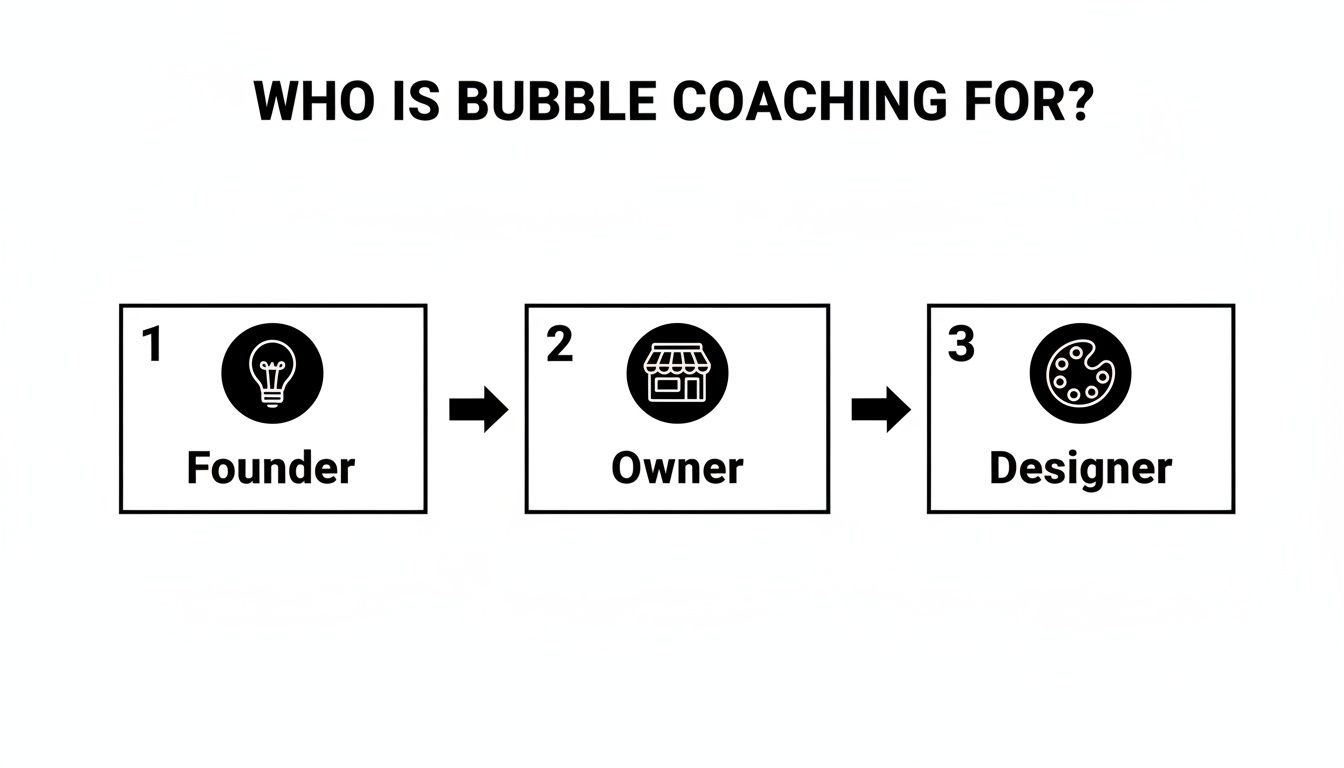
As you can see, founders, business owners, and designers are all trying to get from an idea to a working product. A tailored 1-to-1 session is what helps them make that leap.
The Non-Technical Founder
This is the classic profile: someone with a brilliant app idea but zero coding background. They've probably looked into hiring developers, only to be floored by quotes that would sink a startup budget before it even gets started. Their primary goal is simple but huge: build a Minimum Viable Product (MVP) to prove their concept and get some real user feedback.
Their pain points are usually foundational and can feel completely overwhelming.
Database Design: They struggle to structure data correctly from the start, a mistake that leads to slow, buggy, or totally broken apps later on.
Workflow Logic: Making conditional workflows ("if this happens, then do that") actually work as intended can feel like trying to solve a puzzle with half the pieces missing.
Authentication Issues: Setting up secure user logins and managing permissions is a must-have feature that’s surprisingly tricky to nail.
For a founder, Bubble coaching is about speed and validation. A Codeless.coach expert helps them build that MVP the right way, avoiding costly rebuilds and getting their idea to market months sooner. It's the most direct path from a great idea to a real product without needing a technical co-founder. This kind of rapid building is what makes tools like Bubble so powerful, as you can see in our breakdown of popular no-code platforms.
The Small Business Owner
Small business owners are masters of getting things done, but they’re often drowning in repetitive, manual tasks. They aren't trying to launch the next Facebook. They just want to build custom internal tools that automate their unique processes and give them their time back.
Their challenges usually involve hooking different systems together and creating simple, practical interfaces for their teams to use every day.
API Integration: They need Bubble to talk to the tools they already use—like Google Sheets, Mailchimp, or an inventory system—but the API documentation feels like it’s written in another language.
Data Management: Their goal is a clean dashboard to view sales data, track clients, or manage orders, but getting the data to show up correctly is the real hurdle.
For business owners, coaching delivers an almost immediate return on investment. Every workflow they automate can save dozens of hours a month, freeing them up to work on their business instead of being stuck in it.
The Designer
Designers are visual storytellers. They can create absolutely stunning user interfaces in tools like Figma or Sketch. The frustration kicks in when they try to turn those beautiful, static images into a fully interactive web app. They have the vision, but the technical execution is where everything falls apart.
For a designer, the gap between a flawless Figma file and a working Bubble app can feel enormous. Our 1-to-1 tutoring acts as the bridge, translating their visual language into Bubble's logic so their design integrity is maintained in the final product.
The most common blockers for designers are:
Responsive Design: Getting a pixel-perfect design to look great on every screen size using Bubble's Responsive Engine is a major headache.
Dynamic Data: They get stuck trying to connect their beautiful front-end elements to a back-end database, so the content can change for each user.
User Experience (UX) Workflows: Building smooth, multi-step flows—like a checkout process or an onboarding sequence—requires a grasp of logic that goes way beyond visual design.
For designers, coaching is about empowerment. It hands them the technical keys to build what they can already see in their minds, transforming them from people who deliver mockups into creators who deliver fully functional applications.
A Look Inside A Personalized Coaching Session
Ever wondered what actually happens in a one-on-one Bubble coaching session? It’s not just a Q&A. Think of it as a focused, hands-on workshop where you and your coach jump into your app together, in real-time, to turn a frustrating blocker into a genuine breakthrough.
This isn't about sitting through lectures; it's about active collaboration. We're pulling back the curtain to show you exactly what to expect from our tailored tutoring, from the moment you book your slot to the second you see your new feature click into place. Every part of the process is designed for clarity, ensuring every minute you invest actually pushes your project forward.

The Client Journey From Booking To Building
The whole experience is built around your schedule and your specific goals. It starts with you booking a 60- or 120-minute session that works for you. Before we meet, I'll send a simple pre-session brief asking for access to your app editor and a clear goal for our time. A little bit of prep work here goes a long way—it lets us dive straight into building the moment our call starts.
All sessions happen over Zoom, where we use screen sharing to work directly inside your Bubble editor. This is a "do-with-you," not a "do-for-you" experience. You’ll be the one at the keyboard, clicking and building, as your coach guides you through each step and explains the "why" behind the "how."
The support doesn't stop when the clock runs out. Afterward, you’ll get an email summary and can ask follow-up questions to make sure the concepts really stick. The goal is to reinforce the learning so you can solve similar problems on your own next time. This kind of direct, virtual guidance is powered by a fast-growing industry. The coaching platform market, valued at $3.8 billion in 2025, is projected to hit $11.1 billion by 2035. This tech makes highly effective, one-on-one learning more accessible than ever before. You can read the full research about coaching platform trends to see how technology is shaping this space.
Sample Session Agendas
While every 1-to-1 tutoring session is tailored to your app's specific needs, most challenges fall into a few common categories. Looking at a sample agenda can help you see how we take a big, complex problem and break it down into a concrete, achievable plan for a single 60-minute session.
Here are a couple of real-world examples of what a focused session might look like.
The most effective sessions are those with a single, clear objective. Instead of trying to "build the whole app," we focus on a specific blocker, like "fix my user login workflow," which guarantees a measurable win by the end of our call.
Agenda 1: Structuring Your First MVP Database
(0-10 mins) Goal Alignment & Data Review: We'll quickly talk through your app's core purpose and identify the key "Things" you need (like Users, Products, or Orders).
(10-30 mins) Building Data Types: You’ll create the necessary Data Types in your editor and add the right fields, learning the difference between text, number, and relational data as we go.
(30-50 mins) Establishing Relationships: This is where the magic happens. We'll connect your Data Types together, like linking an 'Order' to a specific 'User' and multiple 'Products'.
(50-60 mins) Q&A and Next Steps: We’ll review the new database structure and map out how you'll use it in your workflows to build your next feature.
Agenda 2: Integrating Your First External API
(0-15 mins) API Documentation Review: We'll dig into the third-party service's documentation together to understand its authentication method and the specific endpoints we need to call.
(15-35 mins) Configuring the API Connector: Back in your Bubble app, you’ll set up the API Connector, add the required headers, and get the connection authenticated.
(35-55 mins) Making The First Call: Time to see if it works! We’ll build a simple workflow to "call" the API and display the data it sends back on a page, confirming everything is hooked up correctly.
(55-60 mins) Next Steps: We'll wrap up by discussing how to use this new data source dynamically throughout your application.
Common Learning Paths And What You Will Master
Most builders find themselves focusing on one of a few key areas at a time. To give you a clearer picture, we've outlined some common learning journeys and the skills you'll walk away with. Think of these as focused tracks designed to take you from stuck to proficient.
Learning Path | Key Skills Covered | Ideal For |
|---|---|---|
MVP Launchpad | Database Architecture, User Authentication, Core Workflows, Repeating Groups, Conditionals | Founders and builders focused on getting their first version launched quickly and correctly. |
Responsive Design | Flexbox Editor, Responsive Rules, Hiding Rules, Mobile-First vs. Desktop-First Strategies | Anyone struggling to make their app look and feel great on all devices, from phones to wide-screen monitors. |
API & Integrations | API Connector, Authentication (OAuth2, Keys), Webhooks, Data Transformation, Error Handling | Developers needing to connect their Bubble app to external services like Stripe, Google Maps, or Airtable. |
Advanced Logic | Backend Workflows, Custom States, Option Sets, Recursive Workflows, Database Optimization | Builders ready to tackle complex features, improve app performance, and scale their application. |
Each path represents a set of building blocks. Mastering one gives you the foundation and confidence to move on to the next, turning you into a more capable and self-sufficient Bubble developer.
How To Choose The Right Bubble Coach
Let's be honest: not all Bubble coaching is the same. Finding the right person for your project isn't just about hiring a platform expert; it's about finding a partner who's genuinely invested in seeing you succeed. A great coach will feel like a secret weapon, while the wrong one can be a fast track to frustration and wasted cash.
Making the right call means looking past the sales pitch. The best coaches have a unique mix of real-world experience, serious technical chops, and a teaching style that actually clicks with how you learn. This section will walk you through how to spot those qualities and find the expert who can get you across the finish line.
Real-World Experience Building And Launching
This is the big one. You need a coach who hasn't just built apps, but has actually launched them into the market. The difference between building an app and building a successful app is massive.
A coach with launch experience knows the whole game, from user acquisition and feedback loops to the messy reality of iterating on a live product. That practical wisdom is gold because their advice goes way beyond just fixing a workflow. They've been in the trenches and can help you sidestep the common mistakes that torpedo new projects before they even get started.
Deep Technical Expertise
Of course, technical skill is non-negotiable. Your coach needs a rock-solid grasp of Bubble's more complex features, because that's usually where people get stuck.
You'll want to see specific expertise in these areas:
The Responsive Engine: They should be able to build fluid, pixel-perfect layouts that look great on any device, no excuses.
The API Connector: A top-tier coach can confidently connect your app to any third-party service you can think of, from Stripe for payments to Google Maps for location data.
Database Architecture: They need to know how to design a clean, scalable database from the ground up—one that won't crumble under pressure as you grow.
These aren't just fancy terms; they're the pillars of any serious web app. A coach who has truly mastered them can solve your gnarliest problems and teach you how to build a product that lasts.
Questions To Ask A Potential Coach
To figure out if a coach is the real deal, you have to ask the right questions. Treat it like an interview for a key business partner. Your goal is to get a feel for their experience, how they think, and whether they can actually teach.
Here’s a checklist of questions to get you started:
"Can you show me a complex app you've built and launched?" This cuts through the talk and gets straight to tangible proof of their abilities.
"How do you approach a problem you've never seen before?" This gives you a window into their problem-solving mindset. A great coach will talk about debugging, researching, and breaking things down logically.
"How would you explain the difference between a custom state and a URL parameter for managing data?" This is a great test of their ability to explain a technical concept clearly and simply.
"Can you share a client success story? What was their biggest challenge, and how did you help them solve it?" This tells you a lot about their coaching style and the kind of results they help people achieve.
A great coach won’t just give you the answer. They'll guide you to it, explaining the 'why' behind every step so you can solve the problem yourself next time. At Codeless.coach, our goal is to make you self-sufficient, not dependent.
By focusing on these criteria and asking sharp questions, you'll be in a much better position to find a true partner—a Bubble coach who will not only help you build your app but also make you a better builder along the way.
Your Pre-Session Checklist For Maximum Progress
If you want to squeeze every last drop of value from your Bubble coaching session, you have to show up prepared. It's that simple. An hour with a great coach can easily save you a week of banging your head against the wall, but that magic only happens if you're ready to hit the ground running.
Think about it: if you spend the first 15 minutes just explaining your problem or fumbling for a password, you've wasted a quarter of your investment. Following this checklist ensures your time is spent building and learning, not just setting the stage.
Define Your Primary Goal
Before the call even starts, you need to know exactly what you want to walk away with. Vague goals like "work on my app" are a recipe for a meandering, unproductive session. You need to get laser-focused on the single biggest thing holding you back right now.
A tailored 1-to-1 coaching session is a surgical strike, not a carpet bomb. Your goal should be a crystal-clear, actionable statement.
Weak Goal: "I want to get better at workflows."
Strong Goal: "I need to build the workflow that lets a user reset their password and sends them a confirmation email."
Having that one, specific objective gives the entire session a North Star. It guarantees you'll leave with a concrete win you can build on.
Coming into a session without a clear goal is like telling a taxi driver to "just drive." You'll spend a lot of time and money, but you might not end up anywhere useful. Pinpoint your destination first.
Gather Your Essential Assets
Once you know your goal, pull together everything your coach might need to see. Having your assets ready to go means you won't waste precious minutes digging through files or trying to remember login details during the call. This one step can easily save 10 minutes of a one-hour session.
Here’s what your pre-session kit should include:
A List of Your Top 3 'Blocker' Questions: What are the exact questions stopping you cold? Writing them down forces you to clarify your thinking and keeps the conversation on track.
Relevant Design Files: If you're building from a Figma or Sketch file, have it open and ready to share. Visual context is everything.
API Documentation: If you’re tackling an integration, have the API docs for that third-party service open in a browser tab. No one wants to watch you Google it.
A Clean Bubble Editor: Close out all the other tabs in your Bubble editor. A clean workspace reduces distraction and makes it way easier for both of you to navigate during a screen share.
Prepare Your Technical Setup
Last but not least, do a quick tech check to make sure your setup won't sabotage the session. Nothing kills momentum faster than a bad connection or a mic that isn't working. A quick 5-minute check is all it takes to avoid the frustration.
Test your microphone and camera on Zoom.
Make sure your internet connection is stable.
Quit any programs you don't need to free up bandwidth.
This kind of prep sets the stage for a great coaching experience. To really get the most from each session and keep the momentum going, it helps to incorporate proven best practices for online learning into your routine.
Common Questions About Bubble Coaching
It's smart to have questions when you're thinking about investing in one-on-one help. This isn't just about learning a new tool; it's about making a solid decision for your project, your timeline, and your budget. My goal here is to give you clear, straightforward answers to the most common things people ask about Bubble coaching at Codeless.coach.
This part of the guide tackles the practical questions that pop up when you're ready to turn your idea into a real, working app. We'll get into timelines, what skills you need (or don't need), and how this personalized approach compares to other ways of learning. The idea is to give you the clarity you need to move forward with confidence.
How Many Sessions Will I Need To Launch?
This is easily the number one question I get asked. The honest-to-goodness answer is: it really depends on what you're building. A simple app for your internal team might be up and running after just a few sessions. On the other hand, a complex marketplace with different types of users is naturally going to take a bit longer.
But here’s the key: coaching drastically cuts down your timeline compared to trying to figure it all out on your own. Instead of getting stuck on a single tricky problem for weeks, we can often solve it together in minutes. That’s the magic of our tailored 1-to-1 tutoring sessions, letting clients launch a fully functional Minimum Viable Product (MVP) way faster than they ever thought possible. If you want to dive deeper into what a smart first version of your app should include, you can learn more about scoping an effective MVP in our guide.
What If I Am a Complete Beginner?
That’s completely fine! In fact, you're exactly the person Bubble coaching was designed for. The whole point of a platform like Bubble is to let people build powerful software without having to write a single line of code. Our tailored sessions start at square one, assuming you have zero prior technical experience.
The best way to learn is by actually doing it. I’ll walk you through core concepts like setting up your database and creating workflows, all while we’re building your app. You don't need to know anything about programming to start; you just need a clear idea of what you want to create.
The biggest hurdle for beginners isn't a lack of technical skill—it's a lack of confidence. A great coach doesn't just teach you the mechanics of Bubble; they show you that you're fully capable of building the app you've imagined by breaking down big problems into small, manageable steps.
Coaching vs. Group Courses: What Is the Difference?
Online courses and group bootcamps can be great for getting a general overview, but they often miss the mark on one crucial thing: personalization. A pre-recorded video can’t help you debug the specific workflow that's giving you a headache, and a group instructor just can't dedicate an entire hour to your unique database challenge.
Our tailored 1-to-1 tutoring gives you a level of focused attention that you simply can't get in a group setting.
Solving Your Problems: Every single minute is spent on your app, your goals, and your specific roadblocks.
Building Your Product: You aren't building a generic to-do list app as a practice exercise. You're building the real product you plan to launch.
Instant, Expert Feedback: You get immediate answers and guidance tailored to your project, which stops you from accidentally building on a shaky foundation.
Think of it like this: a group course is a big university lecture where everyone follows the same curriculum. One-on-one coaching is like having a private tutor who sits down with you to help you write your specific thesis. For anyone with a unique vision, that direct, personalized support is the fastest and most effective way to a successful launch.
Ready to stop wrestling with roadblocks and start building momentum? At Codeless.coach, we specialize in helping founders and creators like you build and launch their apps faster with tailored 1-to-1 tutoring sessions.