Feb 20, 2026
Whats an MVP: whats an mvp and how to build it fast
Wondering whats an mvp? Learn what a Minimum Viable Product is, why you need one, and a practical, code-free path to test your idea fast.
Let's get one thing straight about the term 'Minimum Viable Product'. It’s a term that gets thrown around a lot, and frankly, it’s often misunderstood.
Imagine you've got this grand vision for a car. The old way of thinking would be to spend months, maybe even years, designing and building the entire thing in a garage, only to find out nobody wants it. The MVP approach is different. You start with a skateboard. It's not a car, but it solves the fundamental problem: getting from point A to point B.
That skateboard is your MVP. It’s a smart, strategic first step designed to test your biggest idea with the smallest possible risk.
So, What Exactly Is a Minimum Viable Product?

An MVP isn't a buggy, unfinished product you just shove out the door. That's a common misconception. Think of it more as a calculated experiment. The whole philosophy is about pinpointing the single most crucial problem your customers face and then building only what’s needed to solve that one thing. Everything else can wait.
This "learn first, build later" mindset is a lifesaver for founders, especially if you’re not a coder. It completely flips the script, moving you away from building a product packed with features in isolation and towards launching a simple solution that gets you immediate, real-world feedback. And let me tell you, that early feedback is pure gold for a new startup.
The Real Goal of a Viable Product
So, why go to all this trouble? An MVP has a few critical jobs that can genuinely make or break your entire venture. Its main goals are to:
Test Your Big Idea: The most important question is: does anyone actually care about what you're building? An MVP gives you hard evidence by showing whether people will actually use your solution.
Keep Costs Down: It stops you from pouring thousands of pounds and countless hours into an idea that's completely untested in the real world.
Learn as Fast as Possible: It creates the shortest path from idea to feedback. You launch something small, see how people react, learn from their behaviour, and then adapt. Quickly.
The UK software market is massive—hitting USD 41,919.8 million in 2024—but it’s also fiercely competitive. Founders who can move fast have a huge advantage. This is where no-code tools are changing the game. While a traditionally coded MVP could take 4-6 months, platforms like Bubble.io can cut that down to a matter of days, especially with the right guidance.
If you want to dive deeper into the basics, this is an excellent ultimate guide to a Minimum Viable Product.
To help clarify the core differences in mindset, here’s a quick breakdown of how the MVP approach stacks up against the traditional way of building products.
MVP Core Concepts At a Glance
Concept | MVP Approach (Learn Fast) | Traditional Approach (Build Big) |
|---|---|---|
Primary Goal | Validate a core business assumption. | Launch a complete, feature-rich product. |
Target Audience | A small segment of early adopters. | The broad, mass market. |
Development Focus | Speed and essential functionality. | Perfection and comprehensive features. |
Risk | Low financial and time commitment. | High investment before any validation. |
Feedback Loop | Immediate and continuous. | Delayed until after the full launch. |
Metric for Success | Learning and validated user insights. | Revenue and number of active users. |
As you can see, the two paths are fundamentally different. One is about learning, the other is about launching.
An MVP is the smallest experiment you can build to test a specific hypothesis about your business. It is not about creating a smaller version of a large product; it's about finding the fastest way to start learning.
Ultimately, building an MVP is about swapping guesswork for data. It's the most intelligent way to handle the uncertainty of a new business idea and dramatically increase your odds of creating something people genuinely want and are happy to pay for.
The Strategic Benefits of Building an MVP
So, we know what an MVP is. But the real magic isn't in the what, it's in the why. Building an MVP isn't just a shortcut to launching; it's a powerful strategic move that turns risky guesswork into solid business intelligence.
Imagine a founder with a brilliant app idea. The old way would be to disappear for nine months, spend a small fortune building every single feature, and then hope people like it. The MVP approach? Launch a simple, one-feature version in just four weeks. It's not a lesser product—it’s a smarter one.
Turn Assumptions into Actionable Insights
Here’s the single biggest reason to build an MVP: it drags your assumptions out into the harsh light of reality. Every new business idea rests on a wobbly tower of guesses—that a certain problem exists, that people will pay to solve it, and that your solution is the one they'll choose.
An MVP gives you a direct line to the market, letting you test these assumptions with real users. You stop listening to what people say they’ll do and start watching what they actually do. That’s a game-changer.
An MVP replaces boardroom debates with real-world data. It gives you the evidence you need to decide whether to pivot, persevere, or pull the plug before you’ve spent too much time and money.
Build a Community, Not Just a Product
When you launch an MVP, you start gathering your first tribe of early adopters. These people aren't just your first customers; they're your most passionate collaborators. They're willing to overlook a few rough edges because they believe in the vision, and they'll give you the honest, unfiltered feedback you need to make the product better.
This initial group becomes a loyal community, invested in your success. Their insights are gold when it comes to deciding which features to build next. An MVP also gives you a live testing ground for your pricing—you can experiment with different models to find that sweet spot your customers are happy with.
This is a massive advantage, especially in the UK's crowded software scene, where over 715,000 businesses are vying for attention in a market set to hit £490 billion by 2026. For non-technical founders, no-code tools are a lifesaver, slashing development costs and timelines. You can read more about the UK software development market on Ibis World.
Finally, an MVP is your best fundraising tool. A working product with real, active users is far more convincing to an investor than a PowerPoint presentation. It proves you have traction, that there's a market for your idea, and that you know how to execute. By launching an MVP, you save precious resources while simultaneously building the evidence needed to secure funding for growth.
Picking the Right No-Code MVP for Your Idea
Okay, so you’re sold on the idea of an MVP. That's the easy part. Now comes the real question: which type of MVP should you actually build?
It’s not a one-size-fits-all answer. The right choice depends entirely on what you need to learn right now. Are you just trying to see if anyone even cares about the problem you’ve spotted? Or do you need to test a complicated service that would cost a fortune to automate from day one?
Each question demands a different kind of MVP. Luckily, with no-code tools, you don't need to be a developer to get these up and running.
This decision tree gives you a good mental model for thinking through whether an MVP is the right move for you.
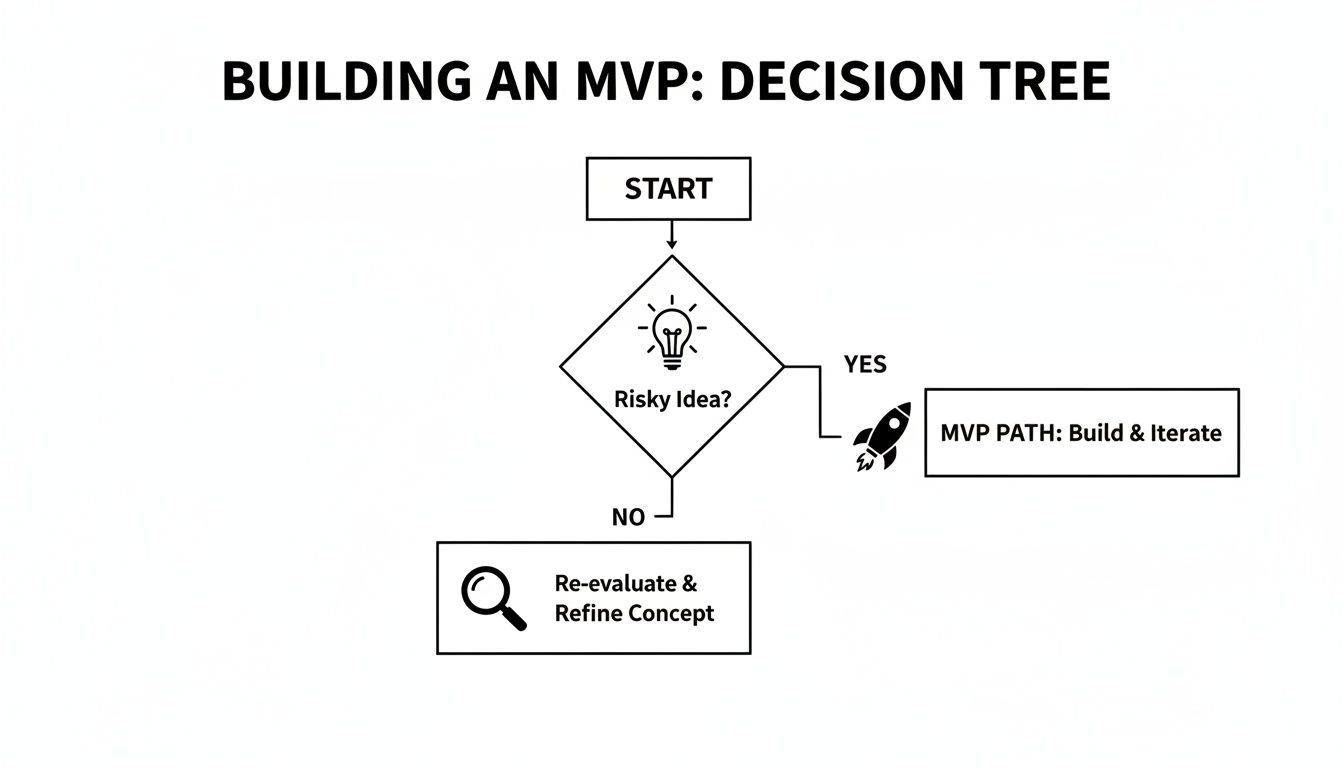
As you can see, the MVP path is tailor-made for those risky, unproven ideas. It's your safety net, allowing you to get real-world feedback before you bet the farm on building something nobody wants.
The Landing Page MVP
Let's start with the simplest, fastest, and often most effective MVP: the Landing Page. Think of it as a digital flyer for a product that doesn't exist yet. Its only job is to see if people are interested enough to stop and listen.
You build a single, sharp-looking web page that nails your value proposition, highlights the key benefits, and has a clear call-to-action—usually an email sign-up box. If a decent number of people give you their email, you've got your first flicker of validation. It’s a sign that the problem you're solving actually resonates.
Best For: Simply testing the demand for an idea before building a single thing.
No-Code Example: You can spin up a professional-looking page on a platform like Bubble.io in a couple of hours. Describe your future product, add a simple form to collect emails, and you’re good to go. The data goes straight into Bubble’s database. This is a brilliant first step for anyone exploring what no-code is and what it can do.
The Wizard of Oz MVP
This one gets its name from the classic film, and for good reason. From the user's perspective, they’re interacting with a fully automated, high-tech system. But behind the curtain? It’s just you, pulling the levers manually.
The Wizard of Oz MVP is perfect for testing a complex service without writing a line of complex code. Imagine an AI-powered meal planning app. In a Wizard of Oz setup, the user fills out a form on a slick interface, but it's you who receives the request, manually creates a meal plan, and emails it back. They get the value; you get the learning.
A Wizard of Oz MVP lets you prove there's demand for a sophisticated service and fine-tune your process based on real customer interactions—long before you spend a penny on expensive automation.
This approach is an absolute goldmine for insights. You’ll quickly learn which parts of your service people truly value and what's just fluff, which directly informs what you should eventually build.
The Single-Feature MVP
Sometimes, your big idea really boils down to one critical, game-changing function. In that case, the Single-Feature MVP is your best friend. Instead of trying to build a product with all the bells and whistles, you build only the one core feature that delivers the main value.
It’s a fantastic exercise in discipline. It forces you to focus relentlessly on the 'Minimum' in MVP. If you're building a new project management tool, you might start by only building the ability to create and assign a task. No calendars, no reporting, no notifications. Just that one core loop.
If people eagerly adopt and use that single feature, you’ve struck oil. It's a powerful signal that you’re onto something and can start building out the rest of the vision with confidence.
Best For: Validating the core function of what will eventually be a much larger app.
No-Code Example: Using Bubble, you could create an app that lets users do just one thing. For example, a bare-bones job board where companies can post a single listing. This tests the central value exchange without getting bogged down building messaging systems, payment gateways, or fancy search filters.
Choosing Your No-Code MVP Type
To make the choice a bit clearer, here's a quick comparison of the common MVP types and what they're best used for, especially when building with no-code tools.
MVP Type | Primary Goal | Example No-Code Tool Stack |
|---|---|---|
Landing Page | Gauge interest & collect leads | Bubble.io, Carrd, or Webflow for the page; Mailchimp for email. |
Wizard of Oz | Test a complex service manually | A Bubble.io or Tally form for the front-end; manual work using Google Sheets & Gmail for the back-end. |
Single-Feature App | Validate the core value proposition | A fully functional, focused app built entirely on Bubble.io or Adalo. |
This table should help you align your immediate goal—whether it's testing an idea, a process, or a function—with the right kind of MVP. Remember, the goal isn't to build a perfect product, but to learn as quickly and cheaply as possible.
Your Step-by-Step MVP Launch Checklist
Getting your first MVP out the door can feel like a monumental task, but it really isn't. The secret is to stop thinking about it as one giant project and start seeing it as a series of small, manageable steps.
This checklist will guide you through that process, turning a vague idea into a live product that gets you the one thing you need most: real-world feedback. Let's break it down.
Step 1: Pinpoint Your Core Problem and Hypothesis
Before you write a single line of code or drag a single element in Bubble, you have to nail two things. First, what’s the one, burning problem you’re trying to solve? And for whom? Get specific. "Helping businesses" is far too broad. "Helping freelance graphic designers create proposals faster" is much better.
Second, form a clear hypothesis. This isn't just an idea; it's a statement you can actually test. For instance: "I believe that freelance graphic designers will pay a monthly subscription for a tool that automatically generates client proposals." This simple sentence becomes the North Star for your entire MVP.
Step 2: Isolate Your Single Most Important Feature
This is where most founders go wrong. The 'Minimum' in MVP is the hardest part to stick to. You have a grand vision, a beautiful, feature-rich product in your head. Now, you need to shelve it. For now.
Look at your hypothesis and ask yourself: what is the absolute bare minimum I need to build to test this? If your hypothesis is about proposal generation, your MVP should do just that. Nothing more. No fancy dashboards, no team collaboration features, no custom branding. Just the core function. Resisting the temptation to add "just one more little thing" is a discipline, but it’s the most crucial one you can learn.
Step 3: Design and Build Your No-Code Solution
With your core feature locked in, it’s time to build. This is where a no-code platform like Bubble becomes your unfair advantage. You can bring your idea to life in a fraction of the time and cost.
Focus on a clean, straightforward user experience that guides people to that one key feature. Don't obsess over pixel-perfect design; 'good enough' is what you're aiming for. The goal is a working tool that delivers on its one promise. If you hit a wall or get tangled up in the technicals, remember that a bit of expert guidance can save you weeks of frustration. You can seriously cut your MVP development time with 1-to-1 Bubble tutoring and power through those roadblocks.
Step 4: Find and Onboard Your First Users
You've built it. Now you need people to use it. This stage is all about good old-fashioned hustle, not big marketing budgets. Your initial target is tiny: find just 10-20 people who deeply feel the pain you're solving.
Fish where the fish are: Spend time in the online communities, forums, and LinkedIn groups your target users already frequent.
Get personal: Ditch the mass emails. Send one-to-one messages explaining the problem you're tackling and ask if they'd be willing to test your solution.
Onboard them yourself: Get on a call and walk them through the product. The raw, unfiltered feedback you get from watching someone use your app for the first time is pure gold.
A crucial piece of advice: don't ask your friends or family. They care about you, which means they'll likely soften their feedback. You need the unvarnished truth from impartial strangers who represent your ideal customer.
Step 5: Establish a Feedback Loop
The entire purpose of launching an MVP is to learn. The final step is to create a simple, repeatable way to collect, organise, and act on what your users are telling you.
This doesn't need to be some complex system. A basic Trello board or even a simple spreadsheet will do the job perfectly. Make it incredibly easy for users to share their thoughts. Ask them direct, open-ended questions like, "What part of this was confusing?" or "Was there anything you expected this to do that it didn't?" Their answers are the fuel for your next development cycle and the whole reason you built the MVP in the first place.
How to Know if Your MVP Is Working
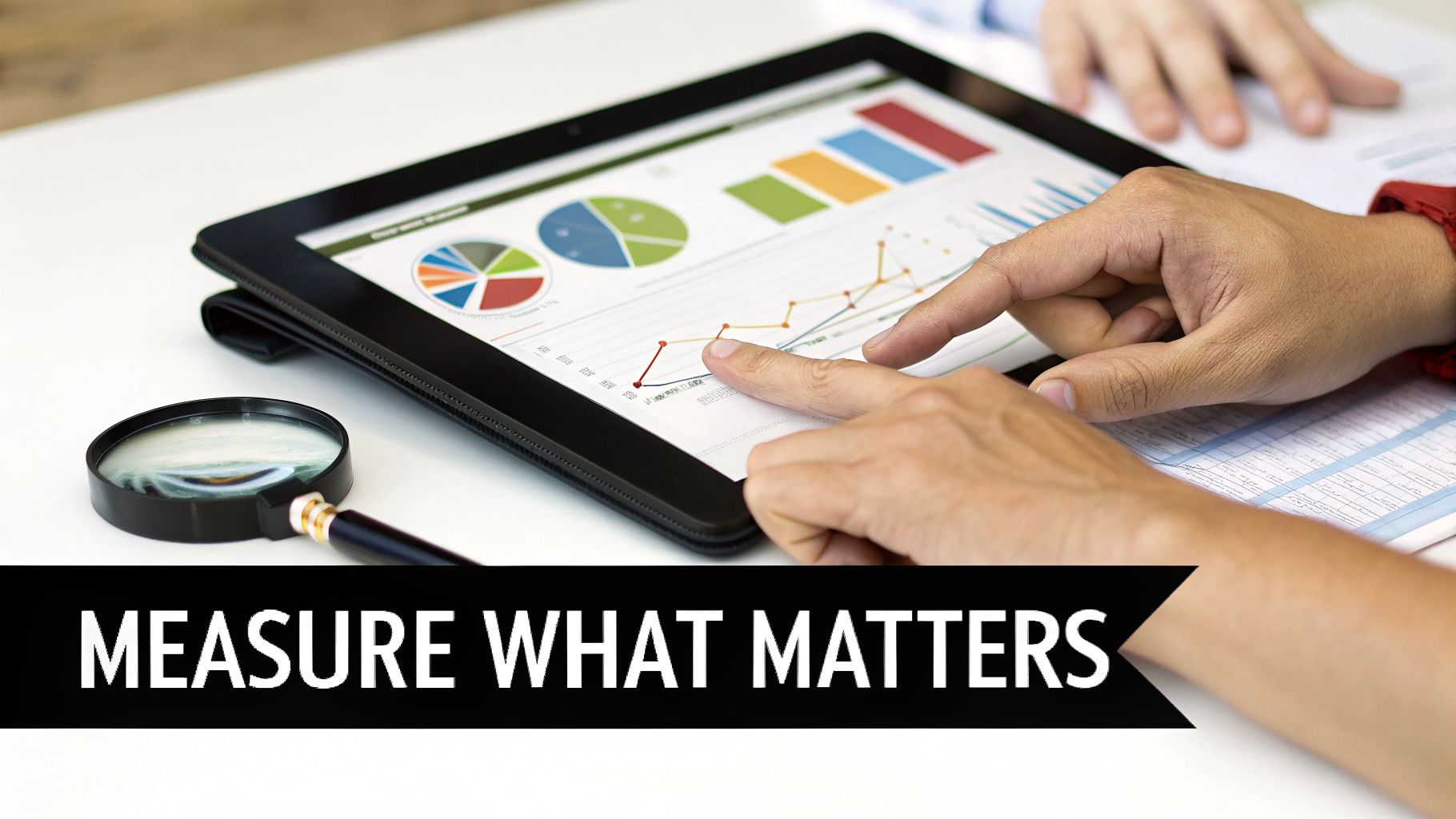
Getting your MVP out the door isn’t the finish line; it’s the starting pistol. Now the real work begins. You need to turn all that early user activity into clear signals that tell you whether your idea actually has legs.
This means you have to learn to ignore the ego-boosting "vanity metrics" like page views or social media likes. Instead, you need to focus on data that reflects what people are actually doing with your product.
The most important question is a simple one: are people using your product to solve the problem you set out to fix? Actionable metrics give you the answer. These are the numbers that tie directly back to your original hypothesis and tell you what to do next – pivot, persevere, or head back to the drawing board.
Key Metrics to Track for Your MVP
Don't get lost in a sea of data. Just concentrate on a few critical indicators that will give you the clearest picture of whether you're hitting the mark.
User Sign-Up Rate: Think of this as your first checkpoint. Are people interested enough to hand over their details and give your solution a go? A steady stream of sign-ups is a great early sign that you've tapped into a real need.
User Engagement and Retention: This is the big one. Do users come back after their first visit? Are they using your core feature over and over again? High engagement is a massive signal that your product delivers genuine value.
Feature Adoption Rate: This metric tells you how many users are actually using the main feature you've built. If adoption is low, it’s a bright red flag that your solution might not be as compelling as you hoped.
Ultimately, an MVP is all about validating your assumptions on the journey towards product-market fit. To see how you're tracking, it's worth digging into these critical Product-market fit questions.
An MVP that generates learning is a success, even if it doesn't generate revenue. Your primary goal at this stage is to gather insights that will inform the future direction of your product.
Making Data-Driven Decisions
Keeping a close eye on these numbers is absolutely essential in the UK’s competitive software development market. It’s a space projected to rocket from US$19.55 billion in 2025 to an incredible US$45.57 billion by 2034. Validating your idea early with a no-code MVP gives you a crucial speed advantage, helping you grab a foothold before everyone else catches on.
By focusing on actionable data, you move beyond guesswork and start making objective, informed decisions. Positive metrics give you the green light to double down and start planning your next set of features. But if the data is ambiguous or negative, don't see it as a failure. It's a valuable lesson telling you it's time to get back out there, talk to your users, and find out what you missed.
Right, so you've launched your MVP. Congratulations! That's a huge step, but honestly, the real work is just beginning. Think of your MVP launch not as the finish line, but as the starting gun for the next race.
You’ve got data trickling in, and maybe even some great feedback from your first users. This is gold. It's the proof you needed that you're onto something. Now, the challenge shifts from "Does anyone want this?" to "How do we build this into a real, sustainable business?"
Your focus needs to pivot from pure validation to strategic growth. The MVP was a question; everything you do from this point on should be based on the answer you received. It's time to take all that messy, real-world feedback and the cold, hard numbers and shape them into a clear roadmap. You're no longer guessing what users want—they're starting to tell you.
Turning Feedback into Features
Those first users? They're your co-founders, in a way. They're giving you a treasure trove of insights: feature ideas, bug reports, and yes, probably a few complaints. Your first job is to dive in and start sorting it all.
Don't just create a long to-do list of every feature request. That's a recipe for chaos. Instead, look for the patterns. Are ten different people stumbling over the same part of your app? Is there a constant clamour for a particular integration? These recurring themes are the building blocks of your product roadmap.
Here’s a classic trap many founders fall into: they immediately start building the most-requested feature. A better move is to prioritise what actually strengthens your core value proposition or solves the biggest headache for your most active users.
This isn't just about tidying up a list; it's about making strategic decisions based on real evidence. It ensures you're spending your time and energy on building things that truly matter to the people using your product.
Getting Your App Ready to Scale
While you're dreaming up new features, you also need to look under the bonnet of your no-code app. The setup that worked perfectly for your first 20 users will likely creak and groan under the weight of 200, let alone 2,000. We need to talk about scalability and performance.
For those of you building on Bubble.io, this means taking a hard look at your database structure and workflows. Are they built efficiently? A few tweaks now can save you from a slow, frustrating app down the line. It's also a good time to think about more powerful third-party integrations to automate tasks you might have been doing by hand.
As you grow, your users' expectations will grow too. They'll want a smoother, more professional experience. This is how you take that brilliant, validated idea and carefully guide it from a simple MVP to a proper business that's ready for whatever comes next.
Even with a solid plan, a few questions always seem to pop up during the MVP process. It's completely normal. Let’s clear up some of the common ones to make sure you're feeling confident as you get ready to build.
How Minimal is "Minimal" When it Comes to My MVP?
This is the big one, isn't it? Your MVP needs to be just big enough to solve one core problem for your ideal customer and test your biggest assumption. In other words, what's the simplest version of your idea that someone would actually find useful?
Think of it this way: you need to deliver a complete experience, even if it's a very simple one. The goal is to provide real value from the moment someone starts using it. It's the difference between giving someone a single wheel versus a skateboard. The skateboard is basic, but it gets them from A to B. The wheel is just a part.
For example, if you're building a marketplace, your MVP might just let users list items and connect with buyers through a simple messaging system. Forget automated payments or complex shipping calculators for now. The point is to learn, not to build the perfect, finished product behind closed doors.
Can I Really Build a Complex App Idea as a No-Code MVP?
Absolutely. While you won't be cloning every last feature of a billion-pound app on day one, you can definitely build an MVP that proves its core concept works.
Let's say you have an 'Uber for X' idea. Your no-code MVP could be a simple interface where customers request a service and providers accept it. All the complex stuff—dynamic pricing, GPS tracking, instant payments—can wait. You first need to prove that people want what you're offering.
The trick is to break down your big idea into its most essential part and build only that. No-code tools are brilliant for this because they let you prove the business model without sinking a fortune into custom development.
The most common and costly mistake is 'building in the dark'—spending too much time adding features before launching. Founders fall in love with their idea and try to perfect it in isolation.
The second biggest misstep? Launching and then completely ignoring user feedback. An MVP is a learning tool. If you aren't listening to what your first users are telling you, you're missing the entire point of building one in the first place.
Ready to turn your idea into a real, working product without getting stuck? Codeless Coach offers 1-to-1 Bubble tutoring to help you build and launch your MVP faster. Book a session and get expert guidance.
Refined using Outrank tool